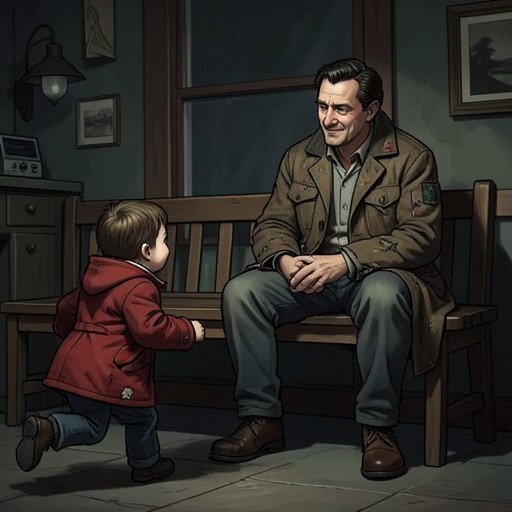
Matt–Noddle-Pete companionship
Ronja, the Robber's DaughterMatt–Noddle-Pete companionship is one of the enduring attachments in Matt’s life: the old robber is at once a trusted adviser, a witness to the family’s defining moments, and the person Matt cannot imagine losing. Their bond is tested by conflict over robbery and by the widening rift between Matt and Ronia, but its deepest measure comes at the end, when Noddle-Pete dies and Matt cries out that he misses him so much it cuts his heart.
A bond present from the beginning
Noddle-Pete is waiting with Matt’s robbers while Lovis gives birth in the tower room. No child has ever been born in Matt’s Fort during their years there, and the old man has particular reason to hope the birth comes soon: he is old and rickety, expects his robbing days to end, and wants to see a new robber chief before he is gone. When Matt rushes into the hall, overwhelmed with joy at having a child, Noddle-Pete asks to hold the baby. Matt lays Ronia in his arms as carefully as if she were a golden egg, and jokingly warns him not to drop the child. The scene establishes Noddle-Pete not as a distant subordinate but as someone trusted with Matt’s most precious new responsibility.
That trust is also visible in the way Matt speaks to the baby. He tells her that she already holds his robber heart in her little hands, revealing a tenderness that unsettles the identity he has inherited and intends to pass on. Noddle-Pete has been hoping to see a new robber chief; Matt even presents the child to him as the future chief. Yet the friendship’s place in the family is more intimate than that shared expectation: the old man is invited to hold Ronia at the moment Matt’s happiness is at its height.
Counsel in the fortress
When Borka’s robbers occupy the North Fort, Matt and his household struggle to understand how the intruders entered. Matt’s first concern is both practical and affronted: anyone approaching the fort should pass through Wolf’s Neck, where a watch is kept day and night, yet no one saw a Borka robber. The predicament gives Noddle-Pete room to do what he repeatedly does for Matt: puncture a mistaken assumption and offer a more useful way of thinking. He asks whether Matt really expected the newcomers to announce their plans to the guard, and later judges that force will not solve the problem. Matt dislikes the foxlike cunning Noddle-Pete recommends, but tries to use it all the same.
Noddle-Pete’s counsel does not mean that he shares every one of Matt’s convictions. As Ronia begins to understand that the goods brought home on the robbers’ horses have been taken from other people, she asks whether the victims become angry. Noddle-Pete cheerfully confirms that they do, even treating their howls, cries, and curses as entertainment. Matt, however, tries to turn the tradition into an inheritance: he tells Ronia that his father and grandfather were robber chiefs, that he has not let them down, and that she is to become one too. Ronia refuses, insisting that she will never do so if the people robbed are angry and crying. Noddle-Pete is present as the generational expectation meets the child’s moral refusal, a conflict that exposes the distance between Matt’s attachment to his daughter and his wish to reproduce his own life in her.
The same difference surfaces when Matt tries to defend his conduct by saying that he takes only from the rich. Ronia’s later answer makes the limit of such excuses unmistakable: he may rob goods, money, and what he calls rubbish, but he cannot rob people without risking her love and filial bond. Matt responds not by accepting her distinction but by turning to his feud with Borka, describing his intended target as a snake fry, a louse, and a thieving hound. The friendship between Matt and Noddle-Pete endures amid this argument, but the old man’s place in Matt’s life does not make him the author of Matt’s choices or erase the harm those choices cause.
A steady presence through estrangement
Noddle-Pete also witnesses the personal cost of Matt’s estrangement from Ronia. After she leaves, the old man greets her return to the stone hall as if she has been rescued from the brink of death, telling her he is glad she is alive and that he had feared for her. Ronia goes to her bed without speaking. Noddle-Pete then describes the desolation of the fort to Lovis: Matt is in his bedroom, lying awake and staring, refusing both to rise and to eat. The man who had once celebrated the arrival of Matt’s child now watches the father become incapacitated by her absence.
Matt’s grief is not confined to the days when Ronia is gone. Little-Snip tells Ronia that nobody has heard Matt laugh since the morning she leaped across Hell’s Gap before his eyes. Lovis later reveals that at night Matt cries in his sleep and calls for Ronia, though when awake he will not even mention her name. Noddle-Pete can no longer bear to have Matt sleeping in his room, and Lovis can scarcely bear it either; still, Matt needs someone to hold on to when things become unbearable. The detail complicates the silence between father and daughter: his daytime refusal to speak of her coexists with a nightly, involuntary call for her, and the people around him must care for a grief he cannot openly express.
At the same time, Matt and Noddle-Pete share a quarrelsome, affectionate familiarity. When the old man speaks of soon being underground, Matt throws his arms around him, lifts him off the floor, and protests that he has not lived a day of his earthly life without him. Noddle-Pete answers with amused composure, looking thoroughly pleased with himself. The exchange turns Matt’s dependence into visible action: he does not merely ask the old man to remain; he physically catches and lifts him, as if affection could hold back the future he fears.
Advice, limits, and loss
When Noddle-Pete devises a plan to settle matters between Matt and Borka, he imagines a single combat that might put Borka in his place and make him reasonable, followed by a united robber band able to mislead the soldiers. Ronia proposes a more fundamental solution: the cleverest idea would be to stop robbing altogether. Noddle-Pete agrees that she is right and calls her bright, but says he is too old and feeble to drum the idea into Matt’s skull. His answer captures both his affection for the child and the limit of his influence over his friend. He can advise Matt on strategy and remain beside him, but cannot make Matt relinquish the life that keeps producing conflict.
When Noddle-Pete finally dies, the old man’s absence is immediate and irreparable. Ronia, who has never seen anyone die, cries; she thinks that perhaps Noddle-Pete had grown so tired that now he can rest somewhere unknown to her. Matt reacts differently and without restraint, pacing the stone hall and shouting that Noddle-Pete had always been there and now is not. Lovis answers that no one can always be there, because everyone is born and dies. Matt’s reply is not an argument but an admission: he misses his old friend so much that it cuts his heart. He accepts Lovis’s offer to hold him and asks for Ronia to be included too. In this final moment, the companionship is shown through its absence: Noddle-Pete’s lifelong constancy has been so complete that Matt can scarcely imagine a life from which it has been removed.